What is a heat pump? How it works, the main types and whether it suits your home
How a heat pump moves heat instead of making it, air source vs ground source, air-to-water vs air-to-air, and what makes a home suitable.
By Revivista Editorial TeamUpdated 4 min read
Safety note: parts of this topic involve electrical, structural or gas work. Rules differ by country and some work must be carried out or signed off by a qualified professional.
A heat pump is a heating system that moves heat from outside into your home instead of burning fuel to make it. It uses electricity to do this, but because it is moving existing heat rather than creating it, it delivers more heat energy than the electricity it uses.
If you have a fridge, you already own a heat pump: it takes heat out of the food compartment and releases it through the back. A heating heat pump does the same thing in the other direction.
How a heat pump works
- Collect: a fluid called a refrigerant flows through a coil outside (or pipes in the ground). Even cold air or soil contains heat, and the refrigerant, which boils at a very low temperature, absorbs it and turns into a gas.
- Compress: an electric compressor squeezes the gas. Compressing it raises its temperature — the same effect that makes a bicycle pump warm.
- Release: the hot gas passes through a heat exchanger and gives its heat to the water in your heating system (or to indoor air). As it cools, it turns back into a liquid.
- Repeat: the liquid passes through an expansion valve, cools sharply and goes back outside to collect more heat.
The ratio of heat delivered to electricity used is called the coefficient of performance (COP). Averaged over a year it is the seasonal COP (SCOP). For example, a SCOP of 3 means about 3 kWh of heat for every 1 kWh of electricity. The real figure depends on the unit, the weather and above all on how hot the water in your radiators has to be.
The main types
| Type | Takes heat from | Delivers heat to | Notes |
|---|---|---|---|
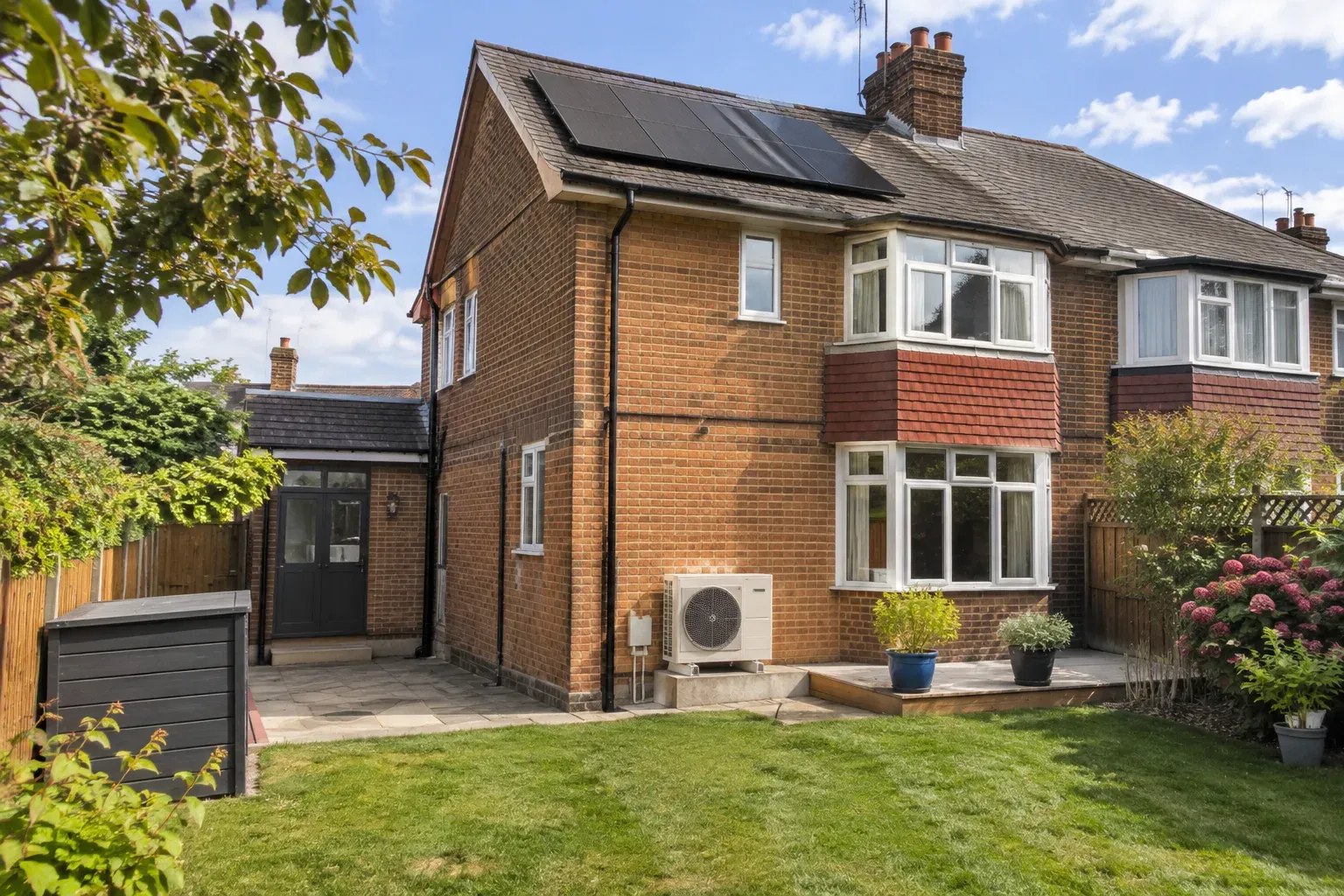
| Air-to-water (air source) | Outside air | Radiators, underfloor heating, hot water cylinder | The most common type in UK homes. An outdoor unit, usually at the side or back of the house. |
| Ground source | Pipes buried in a trench or borehole | Radiators, underfloor heating, hot water | Steadier efficiency, but needs land or a borehole and costs more to install. |
| Air-to-air | Outside air | Indoor air, via wall or ceiling units | Works like air conditioning in reverse and can often cool too. Does not heat your hot water. |
In England and Wales, the Boiler Upgrade Scheme currently offers £7,500 towards an air source or ground source heat pump (air-to-water). Air-to-air systems are not covered by that grant. Check the latest rules on GOV.UK before you apply.
Does a heat pump work in cold weather?
Yes. Heat pumps are designed to keep working well below freezing, and they are widely used in countries with colder winters than the UK. Efficiency does drop when it is very cold, so the system is sized for your home’s heat loss on a cold day.
What differs from a gas boiler is the way it heats:
- It works best at a lower flow temperature for longer periods, keeping the house at a steady temperature rather than heating it up quickly.
- Radiators may feel warm rather than hot. Some rooms may need larger radiators to give out the same heat at a lower temperature.
- Most systems need a hot water cylinder, so a home with a combi boiler needs space for one.
Is your home suitable?
A heat pump can work in most types of home, but an installer will check:
- Heat loss: insulation, draughts and windows. Improving loft and wall insulation first often allows a smaller, cheaper and more efficient system.
- Radiators and pipework: whether they can deliver enough heat at a lower temperature.
- Space: room outside for the unit (with airflow around it) and inside for a cylinder.
- Noise and siting: where the outdoor unit goes relative to bedrooms and neighbours. Many installations count as permitted development, but conditions apply.
Use an MCS-certified installer — it is a condition of the Boiler Upgrade Scheme — and ask for a room-by-room heat loss calculation, not just a quote based on the size of your current boiler.
Pros and cons at a glance
Advantages
- Uses electricity efficiently and produces no emissions at the property
- Can be combined with solar panels
- Long-lasting with little routine maintenance
Drawbacks
- Higher upfront cost than a replacement gas boiler, even with the grant
- May need new radiators, a cylinder and insulation work
- Running costs depend on electricity prices and how well the system is designed
To estimate running costs for your home, try our heat pump cost calculator. For installation costs and the grant in detail, see our heat pump guides.
Heating installations must be designed and fitted by qualified professionals. This article is general information, not installation advice.
Sources
- GOV.UK — Boiler Upgrade Scheme: notice of approved grant categories and values — accessed 7 November 2026
- Energy Saving Trust — Air source heat pumps — accessed 8 November 2026
- MCS — Air source heat pump — accessed 8 November 2026