Paving slabs: porcelain, natural stone or concrete, laying on a mortar bed and how many you need
How to choose paving slabs: porcelain, sandstone, slate or concrete, sub-base and full mortar bed, falls for drainage, jointing and how many slabs to buy.
By Revivista Editorial TeamUpdated 2 min read
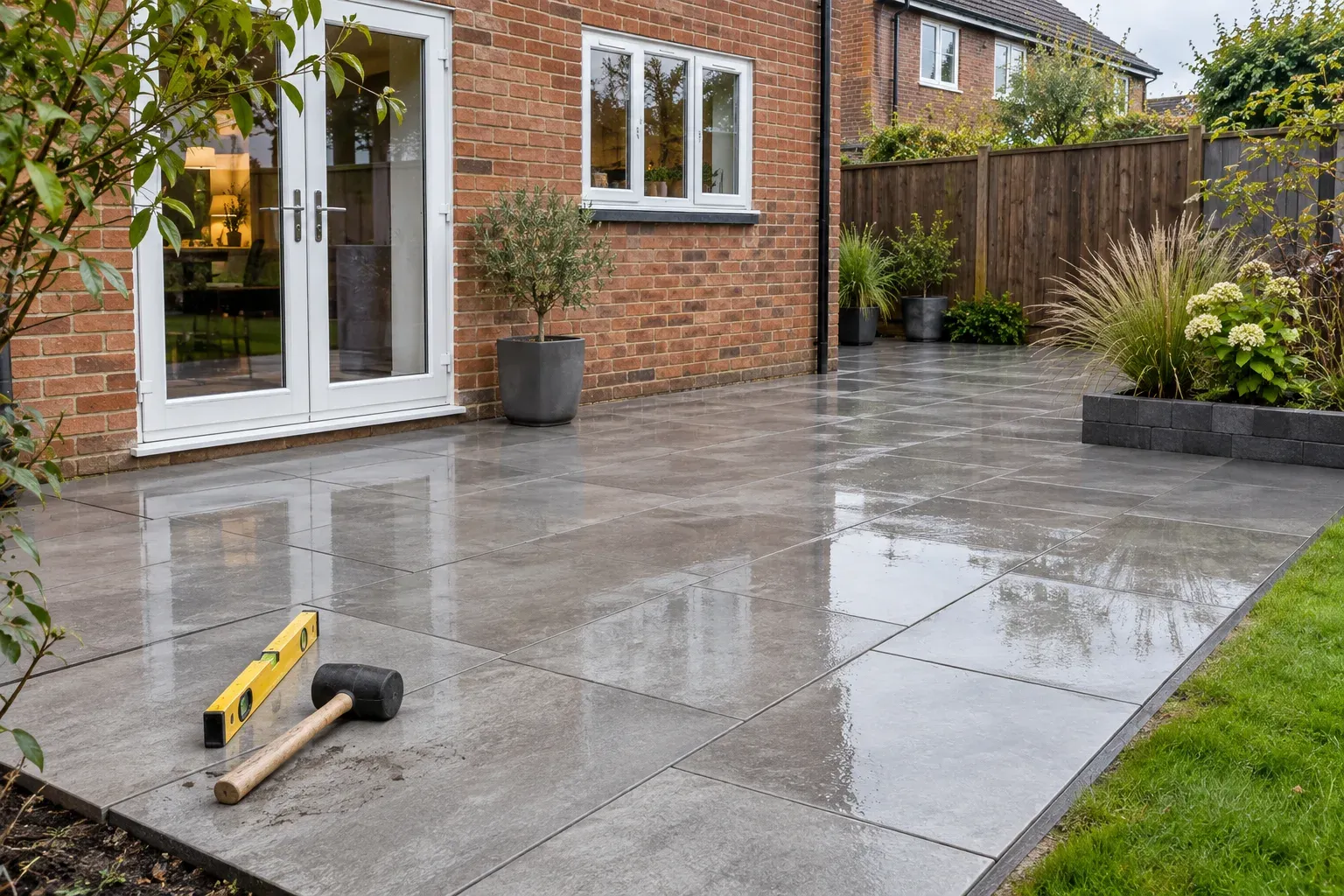
Paving slabs decide how a patio looks, how easy it is to keep clean and how long it lasts. Choosing the material is only half of the job: a patio stands or falls on its sub-base, mortar bed and drainage.
Materials
| Material | Pros | Cons |
|---|---|---|
| Porcelain (often 20 mm) | Very low water absorption, stain-resistant, many looks | Needs a slurry primer to bond to mortar; harder to cut |
| Indian sandstone | Natural, warm colours, affordable for natural stone | Can mark and grow algae; may need sealing |
| Slate and limestone | Elegant, smooth | Some types are slippery when wet or sensitive to stains |
| Concrete slabs | Budget-friendly, robust | Plainer look, can fade |
Choose slabs suited to outdoor use and frost, with a surface that grips when wet.
Laying a patio: the essentials
- Dig out to allow for the sub-base, mortar bed and slab thickness, keeping the finished level below the house damp-proof course.
- Sub-base: a layer of compacted MOT Type 1 (crushed stone), laid and compacted in layers with a plate compactor.
- Falls: set a gentle slope away from the house so rainwater runs off — follow the slab supplier’s guidance.
- Full mortar bed: lay each slab on a full bed of mortar rather than on five dots, which leaves voids that crack slabs and trap water.
- Porcelain: brush a slurry primer onto the back of each slab before laying, or it may not bond.
- Joints: fill with a brush-in or slurry jointing compound once the bed has set.
Permeable paving may be needed in front gardens: in England, paving a front garden over 5 m² with impermeable surfaces that drain onto the road normally needs planning permission — check the current Planning Portal guidance and your local authority.
How many slabs?
- Measure the patio area in square metres (split complicated shapes into rectangles).
- Add around 5–10% for cuts with a straight layout, more for mixed sizes or curves.
- Divide by the area of one slab, or buy by the m² if sold in packs or mixed project packs.
Example: a 5 × 4 m patio = 20 m². With 10% extra: 22 m². With 60 × 60 cm slabs (0.36 m²): 22 ÷ 0.36 = 61.1 → 62 slabs.
Our tile calculator does this sum, and the concrete calculator helps with concrete for edgings or footings.
Quick checklist
- Slab material chosen for look, grip and maintenance
- Level below the damp-proof course
- Compacted sub-base and falls away from the house
- Full mortar bed; slurry primer on porcelain
- Quantity worked out with extra for cuts