How many tiles do I need? Measuring floors and walls, adding wastage and buying boxes
Work out how many floor or wall tiles to buy: measure in square metres, take off what you will not tile, add wastage for cuts and round up to full boxes.
By Revivista Editorial TeamUpdated 3 min read
To work out how many tiles you need, measure the area in square metres, add a margin for cuts and breakages, then divide by the area of one tile and round up. Most tiles are sold in boxes, so finish by rounding up to whole boxes.
Our tile calculator does all of this for tiles and for laminate, vinyl or wood flooring sold in packs.
Step 1: Measure the area
Floors: measure the length and width of the room in metres and multiply them. For L-shaped or irregular rooms, split the floor into rectangles, work out each one and add them together.
Walls: measure the width of each wall and the height you are tiling to — full height, half height or just a splashback. Multiply width × height for each wall and add them up.
Then take off what you will not tile:
- doors and windows on walls,
- on floors, fitted units, a bath or a shower tray if you are not tiling underneath.
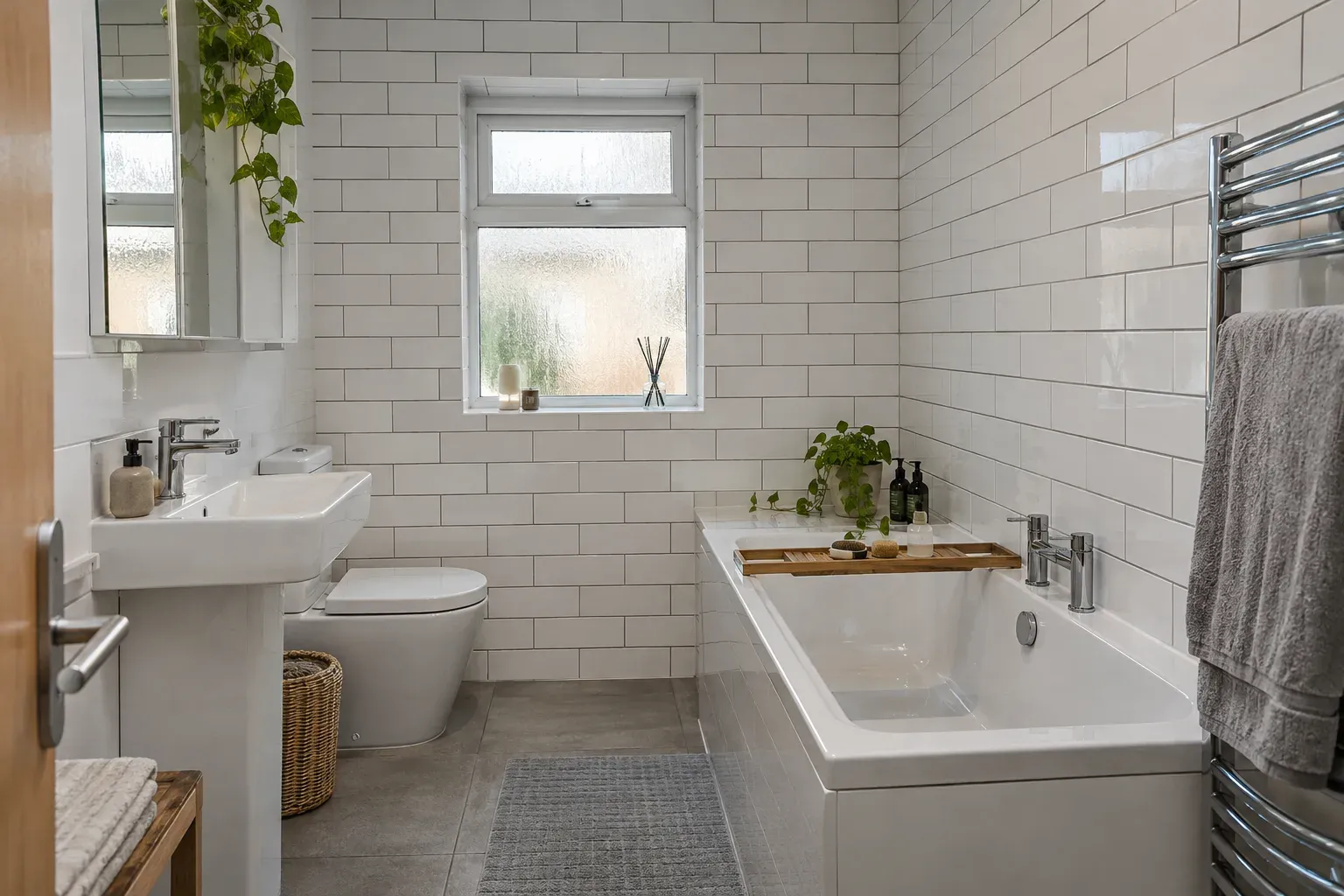
Example: a bathroom floor 2.4 m × 2.0 m = 4.8 m². The bath covers 1.7 m × 0.7 m = 1.19 m² and will not be tiled underneath, so the area to tile is 4.8 − 1.19 = 3.61 m².
Step 2: Add a margin for cuts and breakages
You will always lose some tiles to cuts at the edges, around pipes and in corners — and the odd one breaks.
| Situation | Typical extra |
|---|---|
| Straight laying, simple rectangular room | around 5–10% |
| Lots of corners, pipes or small areas | more than 10% |
| Diagonal, herringbone or other patterns | considerably more — follow the manufacturer’s advice |
| Large-format tiles | can mean more waste per cut, as each offcut is bigger |
Example: 3.61 m² + 10% = 3.97 m².
Step 3: Divide by the size of one tile
Convert the tile size from centimetres to metres and multiply:
Tile area (m²) = length (m) × width (m)
| Tile size | Area of one tile | Tiles per m² |
|---|---|---|
| 30 × 30 cm | 0.09 m² | about 11.1 |
| 30 × 60 cm | 0.18 m² | about 5.6 |
| 60 × 60 cm | 0.36 m² | about 2.8 |
| 10 × 20 cm (metro) | 0.02 m² | 50 |
Example: with 30 × 60 cm tiles, 3.97 ÷ 0.18 = 22.1 → 23 tiles.
Grout joints are ignored in this sum. They make the real number slightly lower, which gives a small extra margin.
Step 4: Round up to whole boxes
Tiles are usually sold in boxes, and the box label normally gives the number of tiles and the area it covers. If a box holds 8 tiles of 30 × 60 cm: 23 ÷ 8 = 2.9 → 3 boxes (24 tiles, 4.32 m²).
If you are buying by the square metre, compare the area you need with the m² per box printed on the label.
Tips before you buy
- Buy all your tiles at once, from the same batch. Colour and size can vary slightly between batches.
- Keep a few spare tiles after the job for future repairs.
- Check the returns policy for unopened boxes before buying a generous margin.
- Order trims, adhesive and grout at the same time. Their coverage per m² is printed on the packaging and depends on the tile size and the trowel used.
- For walls, plan where cut tiles will fall. Starting from the centre of a wall usually gives equal cuts at both ends.
Quick checklist
- Every area measured in metres, including walls and floors separately
- Doors, windows, bath and fitted units taken off
- Margin added for cuts — more for patterns
- Tile count rounded up to whole boxes
- Tiles from one batch, with a few spare